
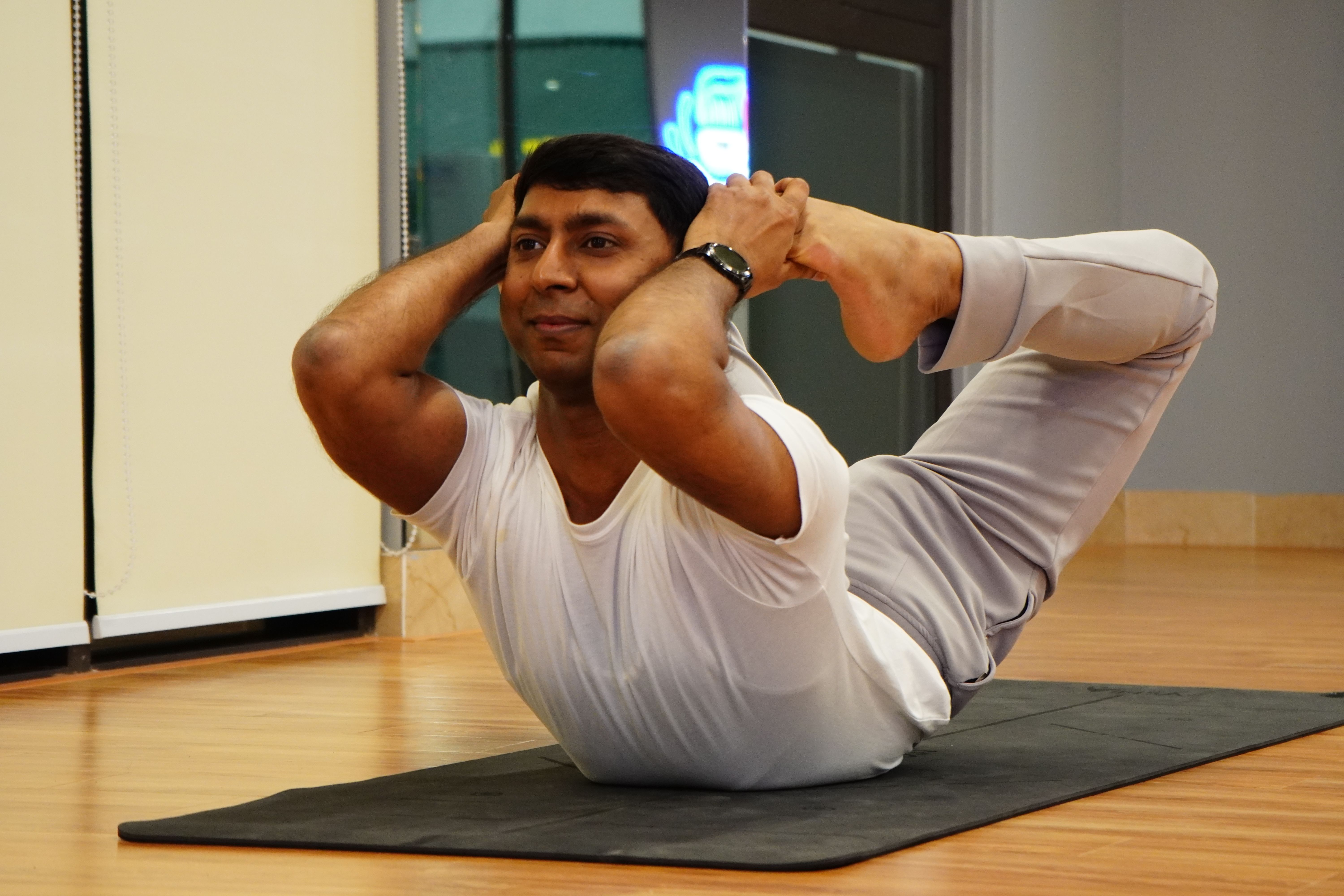
Props in a yoga class are widely read as a concession for beginners. Mechanically they do something else: they alter the geometry of a shape so the intended action becomes available.
Proportions differ more than flexibility does
Limb length relative to torso length varies substantially between people, and that ratio determines whether a hand can reach the floor in a given posture at all.
Hip socket depth and orientation also differ anatomically, which sets an end range that no amount of practice changes because the limit is bone rather than tissue.
A block raises the floor to meet the hand. It is a correction for proportion, not an accommodation for weakness.
Support changes which muscles have to work
When a body is struggling for balance or reach, stabilizing muscles fire to prevent falling, which competes with the lengthening or strengthening the pose was meant to produce.
Removing that instability with a wall or a block frees the nervous system from the balance task, allowing the intended action to occur with attention available for it.
This is why an experienced practitioner may use more props rather than fewer, since precision usually requires the shape to be held rather than fought.
Restorative practice depends on props entirely
Restorative postures are held for long periods with the body fully supported by bolsters and blankets, so muscles have no work to do at all.
Complete support is the condition for the physiological settling these poses aim at, because a muscle holding position keeps a low level of activation running.
Warmth and duration matter for the same reason. Both encourage the shift toward rest that partial support does not reliably produce.
Straps extend reach without collapsing the shape
A strap lets a hand connect to a foot that is out of range, preserving the spinal alignment that would otherwise be sacrificed to close the gap.
Without it, the common compensation is rounding somewhere else, which moves the load to a segment that was not meant to receive it.
The strap therefore protects the shape of the pose rather than substituting for it, which is the opposite of how it is usually perceived.
The culture around props is changing slowly
Classes influenced by alignment-focused lineages have always used them heavily, while flow-oriented gym classes often keep few in the room.
Availability itself shapes use. Students take what is at the wall, so a studio's storage decisions quietly determine how many people practice supported.
For anyone practicing with an injury or medical restriction, the specific modifications should come from a clinician or a teacher trained for that population.